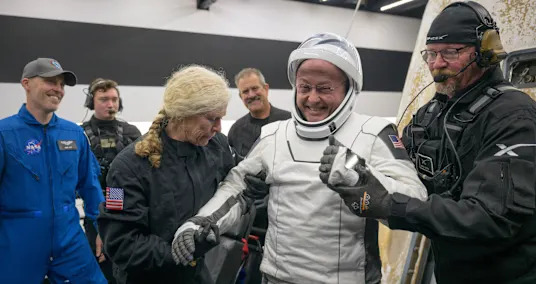
CAPE CANAVERAL, Fla. (AP) — The astronaut who prompted NASA’s first medical evacuation earlier this year said Friday that doctors still don’t know why he suddenly fell sick at the International Space Station.
Four-time space flier Mike Fincke said he was eating dinner on Jan. 7 after prepping for a spacewalk the next day when it happened. He couldn’t talk and remembers no pain, but his anxious crewmates jumped into action after seeing him in distress and requested help from flight surgeons on the ground.
“It was completely out of the blue. It was just amazingly quick," he said in an interview with The Associated Press from Houston's Johnson Space Center.
Fincke, 59, a retired Air Force colonel, said the episode lasted roughly 20 minutes and he felt fine afterward. He said he still does. He never experienced anything like that before or since.
Doctors have ruled out a heart attack and Fincke said he wasn't choking, but everything else is still on the table and could be related to his 549 days of weightlessness. He was 5 ½ months into his latest space station stay when the problem struck like “a very, very fast lightning bolt.”
“My crewmates definitely saw that I was in distress,” he said, with all six gathering around him. “It was all hands on deck within just a matter of seconds.”
Fincke said he can’t provide any more details about his medical episode. The space agency wants to make sure that other astronauts do not feel that their medical privacy will be compromised if something happens to them, he said.
The space station's ultrasound machine came in handy when the event occurred, he said, and he's gone through numerous tests since returning to Earth. NASA is poring through other astronauts' medical records to see if any related instances that might have occurred in space, he said.
Fincke identified himself late last month as the one who was sick to end the swirling public speculation.
He still feels bad that his illness caused the spacewalk to be canceled — it would have been his 10th spacewalk but first for crewmate Zena Cardman — and resulted in an early return for her and their two other crewmates. SpaceX brought them back on Jan. 15, more than a month early, and they went straight to the hospital.
“I’ve been very lucky to be super healthy. So this was very surprising for everyone,” he said.
Fincke stopped apologizing to everybody after NASA's new administrator Jared Isaacman ordered him to stop.
“This wasn’t you. This was space, right?" his colleagues assured him. “You didn’t let anybody down.”
Ever the optimist, he's holding out hope that he can return to space one day.
___
The Associated Press Health and Science Department receives support from the Howard Hughes Medical Institute’s Department of Science Education and the Robert Wood Johnson Foundation. The AP is solely responsible for all content.
LATEST POSTS
- 1
 Journalists killed by Israeli strike in southern Lebanon
 - 2Step by step instructions to Deal with Your Time While Chasing after an Internet based Degree
- 3Rick Steves Doesn't Want You Overlooking This Food Spot While In France
- 4Linda Hamilton, 69, says she doesn't want to 'chase longevity'
- 5Picking the Right Air Purifier for Your Home



- Etymological Experiences on the Wireless transmissions: A Survey of \Learning in a hurry\ Language Web recording
- Nodding off is dangerous. Some animals have evolved extreme ways to sleep in precarious environments
- The Best Web-based Courses for Expertise Improvement
- I visited every country by 25. Antarctica showed me how much I still hadn't seen.
- Oldest evidence of human fire-making discovered at site in England
- Video Conferencing Instruments for Virtual Gatherings
- Top 10 Smash hit Computer games of the Year
- How a niche Catholic approach to infertility treatment became a new talking point for MAHA conservatives
- Smartwatches: Remain Associated and Dynamic