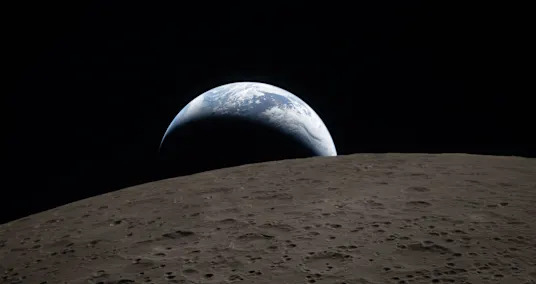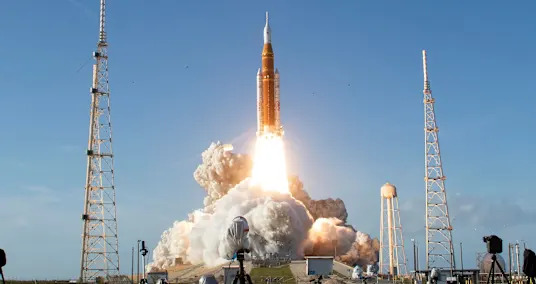
NASA released the first photos of Earth taken by the crew of Artemis II on Friday, hours after the mission left Earth's orbit.
The first photo, taken by Artemis II commander Reid Wiseman, shows the entire planet, and both the Northern and Southern lights are visible over the poles. Zodiacal light, created by sunlight reflecting off dust in the solar system, is visible in the bottom right of the image.
"Hello, World," NASA wrote in the photo caption.
The photo was taken from the window of the Orion capsule, NASA said, after the crew completed their translunar injection burn.
The space agency is also providing a livestream of views from Orion as it travels to and around the moon.

"We see our home planet as a whole, lit up in spectacular blues and browns," NASA wrote on X. "A green aurora even lights up the atmosphere. That's us, together, watching as our astronauts make their journey to the Moon."
Canadian astronaut Jeremy Hansen told NASA's mission control spacecraft communicator that the Artemis II crew was "glued to the window" and "taking pictures" of the planet after breaking out of Earth orbit. In a live conversation with reporters late Thursday night, Wiseman described a moment similar to the one shown in the photograph.
"There was a moment, about an hour ago, where mission control Houston reoriented our spacecraft as the sun was setting behind the Earth…but you could see the entire globe from pole to pole, you could see Africa, Europe, and if you looked really close, you could see the Northern Lights, it was the most spectacular moment, and it paused all four of us in our tracks," Wiseman said at the time.
NASA shared another image that showed a sliver of Earth through the Orion capsule window on X.
The Artemis II is traveling on a trajectory that will carry the astronauts around the far side of the moon on Monday, then bring them back towards Earth. The astronauts aboard the spacecraft are expected to travel farther from Earth than anyone before them, reaching a distance of about 252,021 miles as they pass behind the moon.
In addition to capturing unprecedented images of the far side of the moon, the mission is set to test flight controllers and procedures needed to safely send astronauts back to the moon for long-duration stays as NASA plans for a future moon base.
"This is a test flight," NASA Administrator Jared Isaacman told CBS News. "This is the opening act in a series of missions that will send astronauts to and from the moon with great frequency as we return to stay."
Supreme Court expresses skepticism over Trump order to end birthright citizenship
Watch: Artemis II launches on historic moon mission | Special Report
Iran downs U.S. F-15 fighter jet, sources say | Special Report
LATEST POSTS
- 1
 Study reveals how fast weight returns after ending GLP-1 drugs
 - 2Taste the World: Five Food sources That Have Dazzled Worldwide Palates
- 3As tetanus vaccination rates decline, doctors worry about rising case numbers
- 4NASA astronauts to return from space early due to an 'unexpected medical issue.' What happened — and when are they coming home?
- 5Prehistoric wolf’s gut frozen in time reveals an ice age giant


- Artemis II astronauts channel Apollo 8 with a striking Earthset photo
- International issues on the agenda as Frances's Macron visits China
- Your big brain makes you human – count your neurons when you count your blessings
- 10 Demonstrated Tips to Dominate Video Altering on Your Cell phone in 2023
- December’s full moon is the last supermoon of the year. Here’s what to know
- Most loved Web-based feature: Which Stage Do You Like
- Which Breakfast Enraptures Your Taste Buds? Vote
- Pick Your Favored kind of salad
- Netanyahu expects Iran's leadership to fall